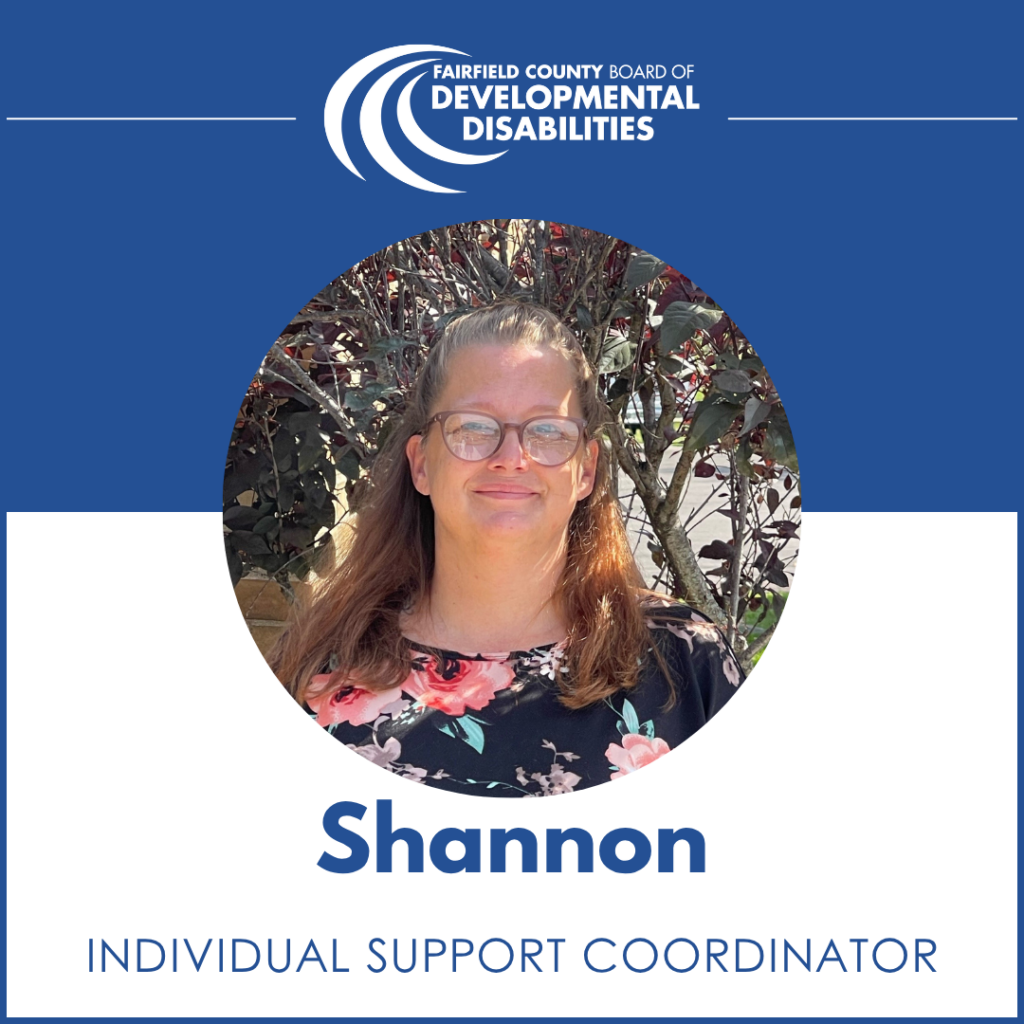
Two years ago, Shannon started her role as an Individual Support Coordinator (ISC) here at
Fairfield DD. Since August, Shannon primarily works with children ages 4 to 13 years old,
and her journey to this line of work began when she was a child herself.
“My grandpa was a social worker before it was an actual established profession. He worked
with what they called back then ‘the troubled youth’,” Shannon said. “Towards the end of
the first semester of my social work degree, I realized I had always had this feeling of
needing to be the person that I didn’t have. You should be proud of yourself because you
grew up to be the safe person you needed, and that’s how I feel now.”
Shannon explained that in her role, she helps parents navigate the system and resources
available. She also works with families on building their confidence and ability to advocate
and model for their children.
“When we start at an early age building the skills and confidence in the parents and the
child, we are laying the foundational work of independence that sets them up for
adulthood,” Shannon explained. “We are building that capacity to live the fullest life
possible. My job description is to get you to a point where you don’t need me anymore. I
want to make myself obsolete.”
Shannon stressed the importance of families reaching out and accepting help.
“Parents don’t want to be a burden, but I’d rather you be a burden right now and take the
help and assistance rather than ten to fifteen years down the road and not have the options
to take the help,” she said. “Help is not a bad word.”
When asked what her favorite part of her role is, Shannon sat back for a moment and
smiled.
“The light bulb moments. When mom, dad, or guardian sees that it makes a difference.
That the doctors were wrong and that the child can do it,” She smiled. “When the families
start to get over the fear and grief of what a diagnosis can bring, or what may come along
with a diagnosis. I am always waiting for that moment of, ‘I don’t need you anymore.’ Of
course, I will be sad, but I will be happy.”
During the interview, we discussed the term success and how that means different things
to each person.
“There is no one success. It can be, ‘I’ve made a friend’ to ‘I spoke a full sentence’ to ‘I
learned how to use my AAC device,” Shannon explained. “For parents, it could be ‘I
advocated for my child and got genetic testing ordered’ or maybe a parent finally feels they
are not alone. Success is as individual and unique as each and every person we encounter
in our role.”
When we asked Shannon what else people should know about her position, she spoke
about a few common misconceptions she encountered.
“A common misconception is that we have all the answers, that being connected to DD
means we will fix everything,” she said. “The reality is, we help you build your toolbox. It’s
easy to pick up a box and throw a tool in it, but it’s good to find tools that you actually need
to help you. Maybe along the way you may find tools that actually help someone else, too.”
“Here’s what to expect: your ISC is not here to do everything for you. We are here to walk
beside you while you learn how to do it. We listen, guide, and help. We are there to listen as
much as we are to guide and support.”
Shannon encourages others who are interested in becoming an ISC to go for it and be
confident in their skills.
“Don’t be scared of it, and don’t let your overthinking talk you out of your own expertise. We
all have something that we are very strong at that feels like breathing to us that benefits
others around us,” She explained. “We just have to figure out how to use it, don’t be afraid
to try!”
At the end of the interview, we asked Shannon if she had any final thoughts or wisdom she
wanted to share. Her first thought was to two of her favorite quotes from the novels, The
Hobbit and The Lord of the Rings: The Fellowship of the Ring.
“Not all who wander are lost, and if I take one more step, that’s the farthest I’ve ever been.
Those ideas. DD is an adventure, it’s not an end, and it’s just the first step on a new journey.
Coming to Fairfield DD has been like coming home in a lot of ways,” she laughed. “Love
what you do, and you’ll never work a day in your life. The families I serve help me as much
as I help them.”